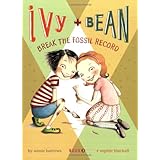
 Module 7- Ivy + Bean Break the Fossil Record
(Book 3)
Module 7- Ivy + Bean Break the Fossil Record
(Book 3)
Summary
Ivy and Bean are two 2nd grade
girls that are come up with a plan to be the youngest paleontologist. The two girls come up with a plan to dig in
Bean’s own backyard. They found bones but they were bones that the dog had
buried.
Reference of Book
Barrows, A. (2007). 3 Ivy Bean:
Break the Fossil Record. San Francisco, CA: Chronicle Books.
Impression
This is a great book for young girls. This
book is a realistic friction that will encourage girls to try anything. It also
encourage the children to try something new and think out of the box.
Professional Reviews
KIRKUS REVIEW
A charismatic duo makes
their debut in this new chapter-book series. Barrows provides a fresh take on
the standard odd-couple tale of friendship, with a caveat to readers of not
judging a book by its cover—or the new girl by her seemingly goody image. Bean,
an energetic girl with an inclination for mischief, just doesn’t see the appeal
of her new neighbor Ivy, whom her mother extols as such a “nice girl,” which
Bean readily translates to mean dull. However, when she needs to escape the
wrath of her bossy sister Nancy, Bean discovers a whole new dimension to the
quiet girl next door. Together Ivy and Bean concoct a plan to cast Ivy’s
fledgling dancing spell on Nancy, with unexpected and hilarious results. With a
hearty helping of younger sibling angst, a sprinkling of spells and potions and
a dash of nosy neighbors, Barrows has the perfect recipe for solidifying a
newfound friendship. Blackall’s saucy illustrations detailing the girls’
hijinks and their calamitous outcomes are liberally featured throughout the
text. Readers are bound to embrace this spunky twosome and eagerly anticipate
their continuing tales of mischief and mayhem. (Fiction. 6-10)
Kirkus Reviews (2006).
Retrieved from https://www.kirkusreviews.com/book-reviews/annie-barrows/ivy-bean/
|
Rhiannon and I selected
our first Ivy and Bean book, Ivy + Bean Break the Fossil Record for
three reasons. First, the cover had two girls on it; second, the cover
illustration was very funny, and third, the book promised to be about fossils
and paleontology. Rhiannon at six years old (she will be seven by the time
this review is published) already styles herself a “junior paleontologist,”
and rightfully so I suppose. She identified her first fossils correctly,
molluscs from the Pliocene Pinecrest Formation of Florida, when she was only
three! And for the past two summers she has worked as a paid assistant in the
paleontology lab at the California Academy of Sciences (earning money for
rubber snakes and Barbie dolls). So, she was naturally intrigued by a book
that claimed to tell the story of the world's youngest paleontologists, and
also one that claimed to break the Fossil Record.
The book is the third in
the Ivy and Bean series by Annie Barrows, and features second grade best
friends Ivy and Bean. The pair are that often-used, but perhaps all too true
odd couple. Ivy is studious, well-mannered and a little shy, while Bean is
outspoken and a bit bored with her age. Any parent of a young girl reading
this might recognize both characters immediately! This installment of
the series opens with a classroom independent reading session, in which Bean
is absolutely bored until the teacher gives her a special book, a book of
world records. Meanwhile, Ivy is engrossed in a book about a character that
should be familiar to all paleontologists, Mary Anning. Mary Anning was a
young girl of the 19th century living in southern England. She is
most famous for her discovery of the first complete ichthyosaur fossil at the
age of 12, though she went on to have an illustrious career, also discovering
the first species of plesiosaur. Bean entertains the class with hilarious
stories of various record breakers (our favourite being the boy who stuck
fifteen spoons to his face), but Ivy is entranced by Anning's story. Bean
eventually decides to be a world record holder, and embarks on several
unsuccessful but hugely entertaining attempts at various records, including
Rhiannon's favourite, the stuffing of the most straws in one's mouth.
(Thankfully, my co-author decided that this was not a good idea, though the
straws had already been purchased). It is at this point that the story comes
together: Ivy and Bean decide to break Mary Anning's record as the world's
youngest paleontologist. What follows is a series of bone discoveries,
childrens' misadventures, and the opening of a new museum. All in a single
backyard!
This book could be
dismissed as just another copy of a Cleary story, or as a silly pun on
paleontological matters, but we think that it has more to offer. Ivy and Bean
are both portrayed as believable characters, exhibiting all the charm of
children at the brink of their ages of discovery. It is hardly ever obvious
what the spark will be for any particular child. For Bean it was the
discovery of world records, while for Ivy, it was that topic that many PE
readers will identify with, paleontology. Barrows is clearly a keen observer
of interactions among children, and that's what this book is all about. Never
mind the scientific inaccuracies which crop up here and there; you'll also
find those in every well respected popular news publication, and even, gasp,
scientific journals. For Rhiannon, the summary of the book is simple: It
features girls, the title is funny because “Record” means both world and
fossil record, Ivy and Bean remind her of her own friends, and they built a
museum with their own fossil discoveries. For me, the book was perfect
bedtime reading with the little one, and was a funny and precious thing to
share as a paleontological parent (I look forward to someday being a fossil
parent). That's a lot of positive gain from a small and simple book.
Epilogue: Mary Anning's
career as a paleontologist is noteworthy because of her discoveries, the
contribution of those discoveries to our understanding of extinction, and her
gender. She was able to support her family as necessary with fossil sales and
patronage. She was eventually granted an annuity by the British Association
for the Advancement of Science and was made an honorary member of the
Geological Society of London. She never, however, held a paid position, nor
was she elected to full membership in these associations, most likely because
of her gender. She died of breast cancer at the young age of 47.
|
|
|
|
Roopnarini, P., &
Roopnarine, S. (2008). Palaeontologia Electronica. Retrieved from http://palaeo-electronica.org/2008_3/books/ivy.htm
Librarian
Use
After students read the book they can make a book
trailer. Students could write a script about the book.
